


Most people who are trying to heal are doing the right things. They’re eating their protein. Taking their supplements. Following the advice they’ve been given. And still — the joint that should be recovering isn’t. The tissue that should be rebuilding isn’t. The brain that should be clearing isn’t.
After 25 years as a clinical dietitian and nutritionist, and after navigating my own decade-long recovery from post-concussive syndrome from college soccer , I can tell you that this isn’t a failure of effort. It’s a failure of understanding how the body actually uses nutrition to heal. And once you understand it, everything changes.
First, Let’s Talk About What’s Happening in Your Gut
Before your body can use protein to rebuild anything, it has to break that protein down into its component amino acids through digestion and absorption. This sounds straightforward. It isn’t.
In my clinical practice, I would estimate that the vast majority of the patients I see — and I mean well over half, likely closer to 80% — have some degree of digestive imbalance. Bacterial dysbiosis, pathogenic overgrowth, fungal imbalance, compromised gut lining. These aren’t fringe conditions. They’re extraordinarily common, particularly in people who have been ill, injured, medicated, or chronically stressed — which describes almost everyone who ends up sitting across from me.
When your digestive environment is compromised, your ability to break down and absorb whole proteins is compromised along with it. You can eat a perfectly constructed meal with an ideal protein source and still end up amino acid deficient at the cellular level. The protein went in. The amino acids never arrived.
This is why I often tell patients: it’s not just what you eat. It’s what you’re actually able to absorb.
The Triage Problem Nobody Talks About
Here’s the second thing most people don’t realize, and it’s the one that I think explains more failed recovery attempts than almost anything else. Your body is always triaging. Every nutrient you consume — every amino acid, every mineral, every vitamin — is used in hundreds, sometimes thousands, of different biochemical reactions simultaneously. And when resources are limited, your body makes choices. It has a hierarchy of priorities, and that hierarchy is ruthlessly focused on survival.
At the top of that hierarchy are the functions your body cannot live without. Cardiac function. Liver function. Neurological signaling. Hormone production. Basic cellular maintenance of your vital organs. These get fed first, always, without negotiation.
Further down the list — significantly further — are things like joint repair. Cartilage regeneration. Connective tissue rebuilding. And how your brain feels on a day to day basis.
I want to sit with that for a moment because it reframes something important. Your body is not equally invested in all of your healing goals. It is primarily invested in keeping you alive. Joint health and cognitive clarity, as important as they are to your quality of life, are low priority items in the body’s resource allocation system. If the amino acids you’re consuming are needed upstream for more critical functions — and they almost always are, especially in someone who is injured, ill, or deficient — they will never reach the tissue you’re trying to rebuild.
This is why people can do everything right and still not get results. The nutrients are being used. Just not for what you intended.
Now Here’s Where It Gets Interesting
This is where I want to introduce what I call the Scrabble Theory of Healing.
Think about amino acids the way you think about letters of the alphabet. A complete protein — whether from animal sources or animal-based protein powders — gives your body something like the full alphabet. All the essential letters, more or less, in whatever ratios occur naturally in that food source. Plant proteins, depending on the source, typically provide a more limited set — missing or severely shortchanging certain essential amino acids, which is why combining plant sources or supplementing strategically matters even more for anyone relying on them.
Now imagine you’re playing Scrabble with the full alphabet in front of you. You have every letter. But having every letter doesn’t mean you’re going to build the word you need. You might build something else entirely. The letters will get used — but not necessarily to spell the word your body needs most right now.
Now imagine instead that someone hands you the specific letters to spell a specific word. H, O, U, S, E. Or T, I, S, S, U, E. Suddenly the outcome isn’t left to chance. The body sees the combination, recognizes the pattern, and knows what to build.
That is the fundamental principle behind targeted amino acid therapy. When you deliver specific amino acids in specific ratios, you are not just providing raw materials. You are providing a signal. A directive. You are telling the body, with biochemical precision, what it should be making with those materials.
This is categorically different from consuming whole protein and hoping the right amino acids filter down to the right tissue at the right time. Targeted formulas bypass the triage problem because they arrive pre-configured for a specific purpose, in concentrations high enough to actually reach the target tissue even after the body has taken what it needs for higher priority functions upstream.
Why Free Form Amino Acids Matter
There is one more piece of this that is worth understanding, particularly for anyone dealing with digestive compromise.
Free form amino acids — meaning amino acids that are already broken down into their individual components rather than bound together in protein chains — do not require the same digestive processing that whole proteins do. They are absorbed directly and rapidly, largely bypassing the gut environment that may be impaired. For someone with dysbiosis, compromised gut lining, chronic illness, or significant injury, this is not a minor distinction. It is often the difference between a supplement that works and one that doesn’t, regardless of what the label says about protein content.
This is why in clinical practice I have consistently seen better outcomes with targeted free form amino acid supplementation than with whole protein sources alone in patients who are actively trying to heal specific tissue. The delivery mechanism matters as much as the ingredient list.
What This Means For You
If you are recovering from injury, managing a chronic condition, dealing with joint degeneration, or simply not getting the results you expect from the protein you’re consuming — the question worth asking is not whether you’re eating enough protein. The question is whether the right amino acids are actually reaching the tissue that needs them, in the right combinations, in sufficient quantities to overcome the body’s triage priorities.
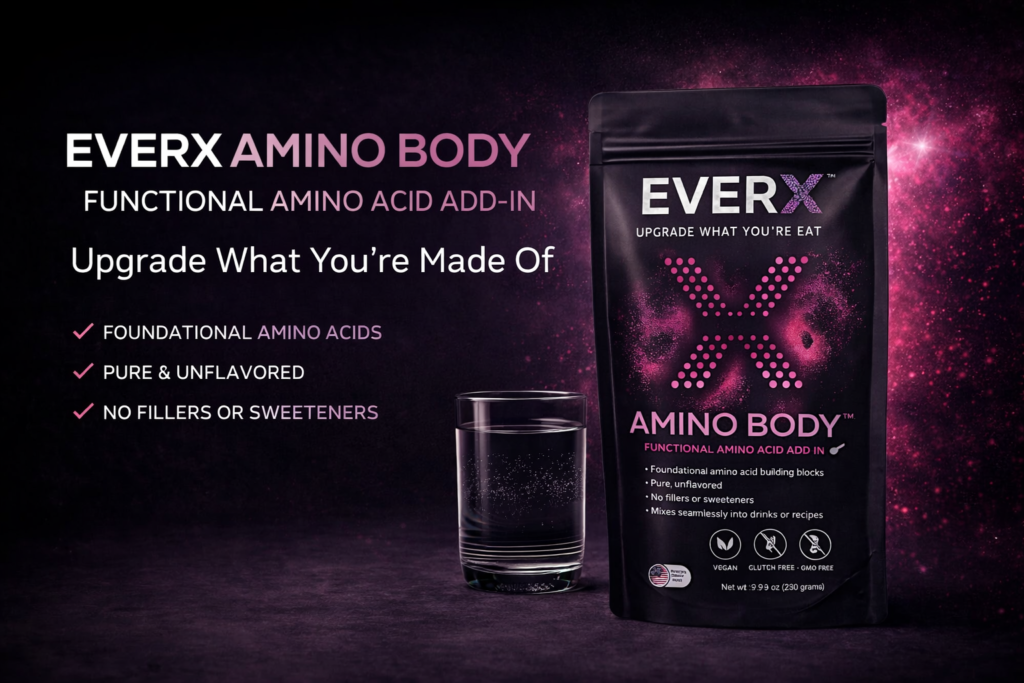
That question is what guided the development of the EverX joint recovery formula. Every ingredient, every ratio, every cofactor was chosen with this framework in mind — not just what the body needs to rebuild joint tissue, but what it needs to actually get those materials to the right place and put them to work. The formula includes targeted free form amino acids alongside the specific vitamin and mineral cofactors — copper, vitamin C, P5P, and B6 — that are required for those amino acids to be metabolized into actual connective tissue rather than redirected elsewhere.
The body wants to heal. In my experience, both clinically and personally, it is remarkably good at healing when you give it precisely what it needs.
The key word is precisely.